
The Renaissance era represents a monumental paradigm shift in human history, an epoch where art, science, and theology converged to redefine humanity’s place in the cosmos. Through the masterful strokes of visionary artists, the flat, ethereal representations of the medieval period were transformed into breathing, psychologically complex tableaus. This comprehensive guide meticulously dissects three of the most culturally significant artworks ever conceived: Fra Angelico’s The Annunciation, Michelangelo’s The Creation of Adam, and Leonardo da Vinci’s The Last Supper. By analyzing their structural geometry, symbolic depth, and technical innovations, we uncover how these artists captured divine interactions and immortalized them on canvas and plaster.
The Annunciation by Fra Angelico: A Divine Oracle in a Golden Halo
Fra Angelico’s The Annunciation, painted in the Convent of San Marco in Florence, stands as a quintessential bridge between the Gothic tradition and the burgeoning Early Renaissance. Unlike the opulent, heavily gilded altarpieces of his predecessors, Fra Angelico utilized a restrained, almost austere visual vocabulary that prioritized spiritual contemplation over material wealth. The fresco captures the precise moment the Archangel Gabriel delivers the divine oracle to the Virgin Mary, enveloping the scene in an atmosphere of profound serenity and sacred quietude.
The Ethereal Atmosphere and Spiritual Geometry
The mastery of Fra Angelico lies in his ability to construct an architectural space that is both mathematically precise and spiritually resonant. The loggia in which the interaction occurs is rendered using the newly developed rules of linear perspective, drawing the viewer’s eye deep into the sacred enclosure. This is not merely a display of technical skill; the architecture itself serves a theological purpose.
To fully grasp the ingenuity of this composition, one must examine the specific spatial dynamics employed by the artist. The arches and columns create a physical boundary that separates the divine event from the mundane world, while simultaneously inviting the monastic viewer into the space of meditation.
- The Hortus Conclusus (Enclosed Garden): Visible just beyond the arches, the meticulously painted garden symbolizes Mary’s virginity and purity. The fence acts as a barrier against worldly corruption, a common motif in Marian iconography that Fra Angelico elevates through naturalistic botanical detailing.
- Architectural Framing: The Corinthian and Ionic columns do more than support the vaulted ceiling; they visually separate Gabriel and Mary, emphasizing the dialogue across the threshold of the divine and the human.
- The Manipulation of Light: Unlike natural sunlight, the illumination in the fresco seems to emanate from within the figures themselves, particularly highlighting the golden halos that signify their holy nature. This diffuse, unearthly light enhances the mystical quality of the oracle being unfolded.
Through these elements, Fra Angelico does not just illustrate a biblical narrative; he engineers an immersive environment designed to facilitate the daily prayer and devotion of his fellow Dominican friars.
Symbolism in the Golden Halo and Posture
The physical postures of Gabriel and Mary communicate volumes about the nature of their interaction. Gabriel leans forward, his multicolored wings still seemingly vibrating with the energy of his celestial descent. His arms are crossed in a gesture of reverence, acknowledging the monumental role Mary is about to undertake. In response, Mary mirrors this gesture, her body slightly bowed in humble acceptance. The golden halos, a holdover from Byzantine art, are rendered here with a physical weight, anchoring the ethereal nature of the figures into the tactile reality of the Renaissance space.

The Creation of Adam by Michelangelo: The Original Desire of Mankind
Suspended high above the floor of the Sistine Chapel, Michelangelo Buonarroti’s The Creation of Adam is arguably the most recognizable fresco in Western art. Painted between 1508 and 1512, this masterpiece departs radically from traditional depictions of the Genesis creation narrative. Instead of showing God molding Adam from clay, Michelangelo captures the electrifying fraction of a second before the divine spark of life is transmitted. It is a profound meditation on the original desire of mankind to connect with its creator, materialized through the agonizingly close, yet unbridled distance between two fingertips.
The Tension of the Untouched Fingertips
The absolute genius of Michelangelo’s composition resides in the negative space—the microscopic gap between the index finger of God and the languid hand of Adam. This void is charged with an almost kinetic energy. If the fingers were touching, the narrative would be complete, and the tension resolved. By leaving them apart, Michelangelo traps the viewer in a perpetual state of anticipation, making the moment eternal.
This compositional choice reflects a deep understanding of narrative pacing and human psychology. The contrast between the two figures amplifies the dramatic effect of this impending connection.
- The Kinetic Energy of the Divine: God is depicted as a dynamic, muscular patriarch, surging forward within a swirling red mantle. His hair and beard are swept back by the sheer velocity of his movement, surrounded by a cohort of angelic figures that add to the forward momentum.
- The Passive Anticipation of Humanity: Adam, in stark contrast, reclines on the barren earth. His anatomy is perfect, reflecting the Renaissance ideal of human proportion, yet he lacks the vital force. His hand is heavy, barely lifted, waiting for the impartation of the soul.
- The Spark of Intellect: The gap represents not just the transfer of physical life, but the transfer of intellect, free will, and the capacity for creation—the very traits that elevate humanity above the beasts in Renaissance humanist philosophy.
This deliberate separation transforms a standard theological illustration into a universal metaphor for human aspiration, the longing for the divine, and the perpetual reach for understanding and perfection.
Anatomical Mastery and Humanistic Philosophy
Michelangelo was first and foremost a sculptor, and his approach to painting the Sistine ceiling was heavily informed by his understanding of three-dimensional form. The figures in The Creation of Adam possess a sculptural mass and muscularity that was unprecedented in fresco painting. Furthermore, modern medical experts have famously noted that the red mantle enveloping God closely resembles the sagittal section of the human brain. Whether intentional or a subconscious byproduct of his extensive anatomical studies, this detail perfectly aligns with the Neoplatonic belief that the highest gift God bestowed upon humanity was the divine intellect.
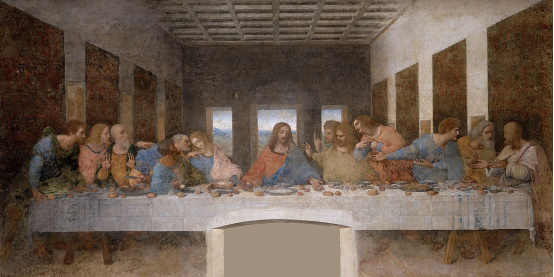
The Last Supper by Leonardo da Vinci: When Time Pauses on Canvas
Housed in the refectory of the Convent of Santa Maria delle Grazie in Milan, Leonardo da Vinci’s The Last Supper is a triumph of psychological complexity and mathematical precision. Executed late in the 15th century, Leonardo chose to depict the highly volatile moment immediately following Christ’s declaration, “One of you will betray me.” By doing so, Leonardo transcends a mere documentation of a meal; he pauses time, capturing the ripple of shock, denial, and anger crashing through the twelve apostles.
Psychological Depth and the Mathematics of Betrayal
Leonardo’s approach to The Last Supper was revolutionary. He abandoned the traditional static arrangement of the apostles sitting quietly in a row. Instead, he organized the twelve disciples into four dynamic groups of three, creating a rhythmic, undulating wave of human emotion that contrasts sharply with the calm, triangular stillness of Christ at the center.
To achieve this profound psychological impact, Leonardo relied heavily on the rigorous application of geometry and linear perspective, ensuring that the viewer’s attention is inextricably drawn to the emotional epicenter of the narrative.
- One-Point Linear Perspective: All the orthogonal lines of the coffered ceiling and the tapestries on the walls converge exactly at the right eye of Jesus. This mathematical focal point anchors the chaotic energy of the apostles, making Christ the physical and spiritual center of the universe.
- The Grouping of Three: The number three resonates throughout the composition—three windows behind Christ, and four groups of three apostles. This not only references the Holy Trinity but also allows Leonardo to contrast different psychological reactions (e.g., Peter’s anger, John’s sorrow, Judas’s recoil) within tight, interactive clusters.
- The Isolation of Judas: Previous artists placed Judas on the opposite side of the table to isolate him. Leonardo brilliantly places him on the same side as Christ but uses shadow and body language to separate him. Judas leans back, clutching the silver purse, his face cloaked in darkness, breaking the horizontal plane of the other disciples.
Through these calculated techniques, Leonardo forces the viewer to engage with the narrative not just as a religious icon, but as a deeply human tragedy unfolding in real-time.
The Tragic Decay and Enduring Legacy of the Fresco
The irony of The Last Supper is that the very experimental nature of Leonardo’s genius led to its rapid deterioration. Dissatisfied with the fast-drying constraints of traditional buon fresco (painting on wet plaster), Leonardo invented a new technique using tempera and oil on a dry wall. This allowed him the time to achieve his trademark sfumato (smoky blending) and intricate details, but the paint failed to adhere properly. Within decades, it began to flake. Despite centuries of damage, restorations, and even surviving a World War II bombing, the ghostly remnants of the mural continue to captivate the world, a testament to the indestructible power of Leonardo’s original composition.
Comparative Analysis of Renaissance Masterpieces
To fully appreciate the magnitude of these three works, it is essential to view them not in isolation, but as milestones in the rapid evolution of Renaissance art. From the serene devotion of the early 1400s to the explosive psychological realism of the High Renaissance, these artists continuously pushed the boundaries of what visual art could achieve. The table below outlines the core differences and evolutionary leaps demonstrated by these masterpieces.
| Artwork & Artist | Era / Style | Medium & Technique | Core Theme & Emotion | Key Artistic Innovation |
|---|---|---|---|---|
| The Annunciation (Fra Angelico) | Early Renaissance | Buon Fresco | Divine Submission, Serenity, and Holy Quietude | Integration of spiritual light with early linear perspective. |
| The Creation of Adam (Michelangelo) | High Renaissance | Buon Fresco | Human Aspiration, Kinetic Tension, and Divine Intellect | Unprecedented anatomical realism and the use of negative space. |
| The Last Supper (Da Vinci) | High Renaissance | Experimental Tempera/Oil on Dry Plaster | Psychological Turmoil, Betrayal, and Mathematical Order | Dynamic grouping of subjects and perfect one-point perspective. |
As illustrated, the progression from Fra Angelico to Michelangelo and Da Vinci represents a shift from depicting heaven on earth to elevating human emotion and anatomy to the level of the divine. Fra Angelico used perspective to create a sacred space; Da Vinci used it to map the human psyche; Michelangelo bypassed architectural framing altogether, using the human body itself as the ultimate architecture of the soul.
Frequently Asked Questions (FAQ)
- Q1: Why did Fra Angelico paint multiple versions of The Annunciation?
- Fra Angelico painted several versions of the Annunciation because it was a central theme of Dominican devotion. The version at San Marco was specifically designed for the private contemplation of the friars, intended to serve as a daily visual aid for prayer and meditation as they walked through the convent corridors.
- Q2: Is the brain shape behind God in The Creation of Adam intentional?
- While Michelangelo left no written confirmation, many art historians and medical experts believe the anatomical accuracy of the brain-shaped mantle is too precise to be accidental. Michelangelo performed extensive human dissections, and integrating the shape of a brain aligns perfectly with the Neoplatonic philosophy that divine intellect is God’s greatest gift to humanity.
- Q3: Why is The Last Supper in such a degraded condition today?
- Unlike traditional fresco technique where pigment is applied to wet plaster (bonding it to the wall), Leonardo da Vinci experimented by painting on dry plaster with an oil and tempera mix. He did this to allow for slower, more detailed work. Unfortunately, the mixture did not bond with the wall, and the damp environment of the refectory caused the paint to begin flaking off within Leonardo’s own lifetime.
- Q4: How did Leonardo da Vinci change the traditional depiction of Judas in The Last Supper?
- Prior to Leonardo, artists typically isolated Judas by placing him alone on the opposite side of the table. Leonardo revolutionized this by placing Judas on the same side as Jesus and the other apostles. He achieved isolation psychologically rather than physically—Judas is the only figure leaning away from Christ, his face is cast in shadow, and he is clutching a small bag of silver.
- Q5: What unifies these three distinct Renaissance masterpieces?
- Despite their differences in style and subject matter, all three masterpieces are unified by the Renaissance pursuit of humanism. They all utilize newly discovered scientific principles—such as linear perspective and anatomical accuracy—not to diminish the divine, but to make the divine more relatable, dramatic, and emotionally accessible to the human observer.


